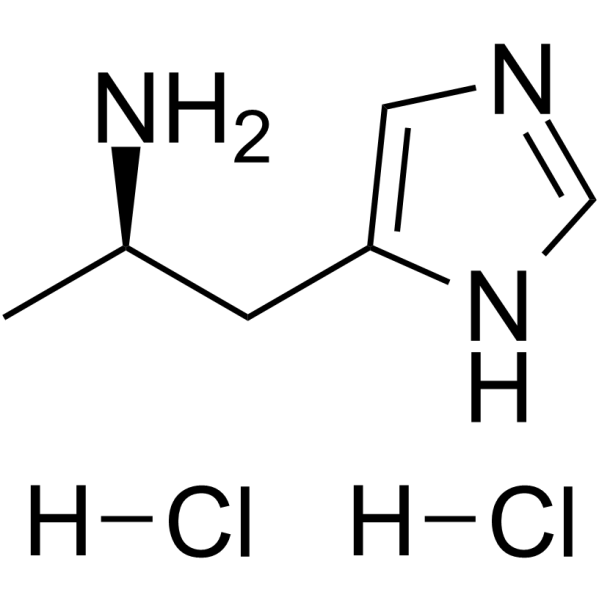
[CAS NO. 75614-89-0] (R)-(-)-α-Methylhistamine dihydrochloride
PRODUCTS SPECIFICATIONS [75614-89-0]

DESCRIPTION [75614-89-0]
Overview
| MDL | MFCD00083176 |
|---|---|
| Molecular Weight | 198.09 |
| Molecular Formula | C6H13Cl2N3 |
| SMILES | [H]Cl.[H]Cl.C[C@@H](N)CC1=CN=CN1 |
Summary
IC50 & Target
|
H 3 Receptor 50.3 nM (Kd) |
In Vitro
(R)-(-)-α-Methylhistamine dihydrochloride is an H3-agonist that is >10 times as potent as histamine (HA). Its selectivity toward H3-receptors is >1000 times as high as that of HA. (R)-(-)-α-Methylhistamine dihydrochloride has only weak affinities for H1 and H2 receptor with a pK i =4.8 and <3.5, repectively. (R)-(-)-α-Methylhistamine dihydrochloride displays >200-fold selectivity over H4 receptors [1] [2] [3] .
MCE has not independently confirmed the accuracy of these methods. They are for reference only.
In Vivo
Pretreatment with (R)-(-)-α-Methylhistamine dihydrochloride (RAMH; 10 mg/kg; i.p.; 60 min before training) reverses Propofol‐induced (25 mg/kg; i.p.; 30 min before training) memory retention
[5]
.
(R)-(-)-α-Methylhistamine dihydrochloride (6.3 mg/kg; i.p.) significantly decreases the steady-state t-MH level in the mouse brain, whereas these compounds produced no significant changes in the HA level
[3]
.
MCE has not independently confirmed the accuracy of these methods. They are for reference only.
| Animal Model: | Male Sprague‐Dawley rats (10-12 week) [3] |
| Dosage: | 10 mg/kg |
| Administration: | IP; 60 min before training |
| Result: | Reversed propofol‐induced memory retention. |
Appearance
Solid
Shipping
Room temperature in continental US; may vary elsewhere.
Storage
4°C, sealed storage, away from moisture
* In solvent : -80°C, 6 months; -20°C, 1 month (sealed storage, away from moisture)
Solvent & Solubility
DMSO : 250 mg/mL ( 1262.05 mM ; Need ultrasonic)
Stock Solutions
| Concentration Solvent Mass | 1 mg | 5 mg | 10 mg |
|---|
| 1 mM | 5.0482 mL | 25.2411 mL | 50.4821 mL |
| 5 mM | 1.0096 mL | 5.0482 mL | 10.0964 mL |
| 10 mM | 0.5048 mL | 2.5241 mL | 5.0482 mL |
References
- [1] Arrang JM, et al. Highly potent and selective ligands for histamine H3-receptors. Nature. 1987 May 14-20;327(6118):117-23.
- [2] Mohammad Shahid, et al. Histamine, Histamine Receptors, and their Role in Immunomodulation: An Updated Systematic Review. The Open Immunology Journal, 2009, 2, 9-41.
- [3] Oishi R, et al. Effects of the histamine H3-agonist (R)-alpha-methylhistamine and the antagonist thioperamideon histamine metabolism in the mouse and rat brain. J Neurochem. 1989 May;52(5):1388-92.
- [4] Yamasaki S, et al. The disposition of (R)-alpha-methylhistamine, a histamine H3-receptor agonist, in rats. J Pharm Pharmacol. 1994 May;46(5):371-4.
- [5] Li WW, et al. (R)-alpha-methylhistamine suppresses inhibitory neurotransmission in hippocampal CA1 pyramidal neurons counteracting propofol-induced amnesia in rats. CNS Neurosci Ther. 2014 Sep;20(9):851-9.