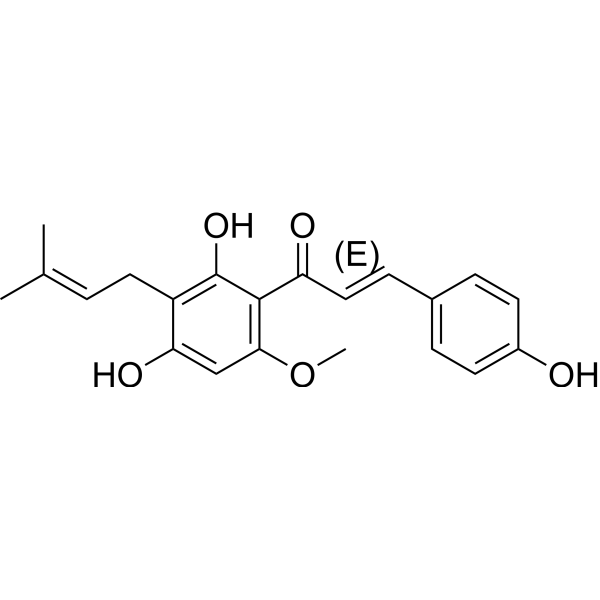
[CAS NO. 6754-58-1] Xanthohumol
PRODUCTS SPECIFICATIONS [6754-58-1]

DESCRIPTION [6754-58-1]
Overview
| MDL | MFCD00210576 |
|---|---|
| Molecular Weight | 354.40 |
| Molecular Formula | C21H22O5 |
| SMILES | O=C(C1=C(OC)C=C(O)C(C/C=C(C)\C)=C1O)/C=C/C2=CC=C(O)C=C2.[(E)] |
5 Publications Citing Use of MCE
Summary
Xanthohumol is one of the principal flavonoids isolated from hops, the inhibitor of diacylglycerol acetyltransferase ( DGAT ), COX-1 and COX-2 , and shows anti-cancer and anti-angiogenic activities. Xanthohumol also has antiviral activity against bovine viral diarrhea virus (BVDV) , rhinovirus , HSV-1 , HSV-2 and cytomegalovirus (CMV) .
IC50 & Target
|
COX-1
|
COX-2
|
HSV-1
|
HSV-2
|
DGAT1 40 μM (IC 50 ) |
DGAT2 40 μM (IC 50 ) |
CMV
|
In Vitro
Xanthohumol significantly attenuates ADP-induced blood platelet aggregation, and significantly reduces the expression of fibrinogen receptor (activated form of GPIIbIIIa) on platelets' surface
[1]
.
Xanthohumol (5-50 nM) reduces the frequency of spontaneously occurring Ca
2+
sparks and Ca
2+
waves in control myocytes and in cells subjected to Ca
2+
overload caused by: (1) exposure to low K
+
solutions, (2) periods of high frequency electrical stimulation, (3) exposures to isoproterenol or (4) caffeine. Xanthohumol (50-100 nM) reduces the rate of relaxation of electrically- or caffeine-triggered Ca
2+
transients, without suppressing I
Ca
, but this effect is small and reversed by isoproterenol at physiological temperatures. Xanthohumol also suppresses the Ca
2+
content of the SR, and its rate of recirculation
[2]
.
Treatment of endothelial cells with Xanthohumol leads to increased AMPK phosphorylation and activity. Functional studies using biochemical approaches confirm that AMPK mediates Xanthohumol anti-angiogenic activity. AMPK activation by Xanthohumol is mediated by CAMMKβ, but not LKB1. Analysis of the downstream mechanisms shows that Xanthohumol-induced AMPK activation reduces nitric oxide (NO) levels in endothelial cells by decreasing eNOS phosphorylation. Finally, AKT pathway is inactivated by Xanthohumol as part of its anti-angiogenic activity, but independently from AMPK, suggesting that these two signaling pathways proceed autonomously
[3]
.
Xanthohumol significantly reduces cell viability and induces apoptosis via pro-caspase-3/8 cleavage and poly(ADP ribose) polymerase (PARP) degradation. Pro-caspase-9 cleavage, Bcl2 family expression changes, mitochondrial dysfunction, and intracellular ROS generation also participate in Xanthohumol-induced glioma cell death. Xanthohumol's inhibition of the IGFBP2/AKT/Bcl2 pathway via miR-204-3p targeting plays a critical role in mediating glioma cell death
[4]
.
MCE has not independently confirmed the accuracy of these methods. They are for reference only.
Clinical Trial
| NCT Number | Sponsor | Condition | Start Date | Phase |
|---|---|---|---|---|
| NCT05524714 | University of Bonn|University of Hohenheim |
Plasmakinetics of Xanthohumol
|
August 1, 2022 | Not Applicable |
| NCT01367431 | Oregon State University|Oregon Health and Science University|National Center for Complementary and Integrative Health (NCCIH) |
Metabolic Syndrome
|
August 2011 | |
| NCT05463393 | Medical University of Lublin |
COVID-19 Respiratory Infection
|
October 1, 2020 | Early Phase 1 |
| NCT04590508 | National University of Natural Medicine|Oregon State University|Pacific Northwest National Laboratory |
Crohn Disease
|
October 1, 2020 | Phase 2 |
| NCT02432651 | Oregon State University |
Oxidative Stress
|
March 2015 | Phase 1 |
| NCT03735420 | National University of Natural Medicine|Oregon State University|Pacific Northwest National Laboratory |
Healthy
|
August 12, 2019 | Phase 1 |
| NCT04847193 | University of Vienna |
Inflammatory Response
|
June 13, 2019 | Not Applicable |
Appearance
Solid
Source
Shipping
Room temperature in continental US; may vary elsewhere.
Storage
| Powder | -20°C | 3 years |
|---|---|---|
| 4°C | 2 years | |
| In solvent | -80°C | 6 months |
| -20°C | 1 month |
Solvent & Solubility
DMSO : 83.33 mg/mL ( 235.13 mM ; Need ultrasonic)
Stock Solutions
| Concentration Solvent Mass | 1 mg | 5 mg | 10 mg |
|---|
| 1 mM | 2.8217 mL | 14.1084 mL | 28.2167 mL |
| 5 mM | 0.5643 mL | 2.8217 mL | 5.6433 mL |
| 10 mM | 0.2822 mL | 1.4108 mL | 2.8217 mL |
-
1.
-
2.
Add each solvent one by one: 10% DMSO >> 90% (20% SBE-β-CD in saline)
Solubility: ≥ 2.08 mg/mL (5.87 mM); Clear solution
References
- [1] Luzak B, et al. Xanthohumol from hop cones (Humulus lupulus L.) prevents ADP-induced platelet reactivity. Arch Physiol Biochem. 2016 Nov 18:1-7
- [2] Arnaiz-Cot JJ, et al. Xanthohumol modulates calcium signaling in rat ventricular myocytes: Possible Antiarrhythmic properties. J Pharmacol Exp Ther. 2016 Nov 4. pii: jpet.116.236588
- [3] Gallo C, et al. Hop derived flavonoid xanthohumol inhibits endothelial cell functions via AMPK activation. Oncotarget. 2016 Aug 1
- [4] Chen PH, et al. The miR-204-3p-targeted IGFBP2 pathway is involved in xanthohumol-induced glioma cell apoptotic death. Neuropharmacology. 2016 Nov;110(Pt A):362-75.
- [5] Inokoshi J, et al. Expression of two human acyl-CoA:diacylglycerol acyltransferase isozymes in yeast and selectivity of microbial inhibitors toward the isozymes. J Antibiot (Tokyo). 2009;62(1):51-54.
- [6] Buckwold VE, et al. Antiviral activity of hop constituents against a series of DNA and RNA viruses. Antiviral Res. 2004 Jan;61(1):57-62.
Synonyms