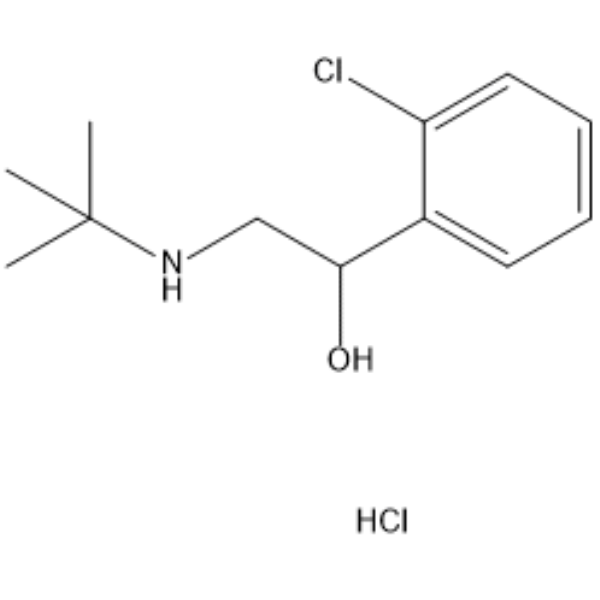
[CAS NO. 56776-01-3] Tulobuterol hydrochloride
PRODUCTS SPECIFICATIONS [56776-01-3]

DESCRIPTION [56776-01-3]
Overview
| MDL | - |
|---|---|
| Molecular Weight | 264.19 |
| Molecular Formula | C12H19Cl2NO |
| SMILES | CC(C)(NCC(O)C1=CC=CC=C1Cl)C.Cl |
1 Publications Citing Use of MCE
Summary
Tulobuterol hydrochloride (C-78) is a long-acting β 2 -adrenoceptor agonist, which reduces the frequency of exacerbations of chronic obstructive pulmonary disease and bronchial asthma. Tulobuterol hydrochloride is also a sympathomimetic agent used as a transdermal patch, increases normal diaphragm muscle strength [1] . Tulobuterol hydrochloride inhibit rhinovirus replication and modulate airway inflammation [2] .
IC50 & Target
β2-adrenoceptor [1]
In Vitro
Tulobuterol (0.1 μM; 24 hours or 72 hours; human tracheal epithelial cells) treatment decreases the RV14 RNA levels at 1 day and at 3 days after infection. The concentrations of sICAM-1 in the supernatants of the cells treated with tulobutero are significantly lower than those in the cells treated with vehicle before RV14 infection. Treatment with tulobuterol reduces the number of acidic endosomes with green fluorescence in the cells and the fluorescence intensity of acidic endosomes in the cells. Also reduces the RV14 infection-induced secretion of IL-1β, IL-6, and IL-8. Tulobuterol treatment produces a small but significant reduction in the amount of p50, p65, and c-Rel of NF-κB induced by RV14 infection [1] .
MCE has not independently confirmed the accuracy of these methods. They are for reference only.
RT-PCR [1]
| Cell Line: | Human tracheal epithelial cells infected with RV14 |
| Concentration: | 0.1 μM |
| Incubation Time: | 24 hours or 72 hours |
| Result: | Decreased the RV14 RNA levels at 1 day and at 3 days after infection. The concentrations of sICAM-1 in the supernatants of the cells were significantly lower. Reduced the number of acidic endosomes with green fluorescence in the cells and the fluorescence intensity of acidic endosomes in the cells. Also reduced the RV14 infection-induced secretion of IL-1β, IL-6, and IL-8. And produced a small but significant reduction in the amount of p50, p65, and c-Rel of NF-κB induced by RV14 infection. |
In Vivo
In vivo effect of Tulobuterol is examined the on the contractility of diaphragm muscles prepared from mice (BALBs/c mice; 21.7 ± 0.2 g) treated with Endotoxin. Contractile parameters of force-frequency curves and twitch kinetics using untreated or treated diaphragm muscles at 0 (E0) and 4 (E4) hours after E. coli endotoxin (20 mg/kg) administration are measured. E0 and E4 diaphragm muscles are analyzed at 0, 12, and 24 h after transdermal Tulobuterol treatment. The force-frequency curves of E0 and E4 diaphragm muscles at three time points are not significantly changed each other, indicating that Tulobuterol patch restores the muscle contractility. Thus, diaphragm muscle contractility is maintained during 4 h of endotoxin administration with Tulobuterol patch for over 24 h [3] .
MCE has not independently confirmed the accuracy of these methods. They are for reference only.
Clinical Trial
| NCT Number | Sponsor | Condition | Start Date | Phase |
|---|---|---|---|---|
| NCT04057469 | Seoul National University Hospital|Samsung Medical Center|Chung-Ang University Hosptial, Chung-Ang University College of Medicine|Severance Hospital |
Tonsillar Hypertrophy
|
December 20, 2019 | Not Applicable |
| NCT00950794 | GlaxoSmithKline |
Asthma|Bronchial Asthma
|
September 2003 | Phase 4 |
| NCT01465906 | Shanghai Zhongshan Hospital |
Chronic Obstructive Pulmonary Disease
|
November 2010 | Phase 4 |
Appearance
Solid
Shipping
Room temperature in continental US; may vary elsewhere.
Storage
4°C, sealed storage, away from moisture
* In solvent : -80°C, 6 months; -20°C, 1 month (sealed storage, away from moisture)
Solvent & Solubility
H 2 O : 100 mg/mL ( 378.52 mM ; Need ultrasonic)
DMSO : 50 mg/mL ( 189.26 mM ; Need ultrasonic)
Stock Solutions
| Concentration Solvent Mass | 1 mg | 5 mg | 10 mg |
|---|
| 1 mM | 3.7852 mL | 18.9258 mL | 37.8515 mL |
| 5 mM | 0.7570 mL | 3.7852 mL | 7.5703 mL |
| 10 mM | 0.3785 mL | 1.8926 mL | 3.7852 mL |
-
1.
Add each solvent one by one: PBS
Solubility: 100 mg/mL (378.52 mM); Clear solution; Need ultrasonic
-
2.
-
3.
Add each solvent one by one: 10% DMSO >> 90% (20% SBE-β-CD in saline)
Solubility: ≥ 2.5 mg/mL (9.46 mM); Clear solution
-
4.
Add each solvent one by one: 10% DMSO >> 90% corn oil
Solubility: ≥ 2.5 mg/mL (9.46 mM); Clear solution
References
- [1] Shindoh C, et al. Tulobuterol patch maintains diaphragm muscle contractility for over twenty-four hours in a mouse model of sepsis. Tohoku J Exp Med. 2009 Aug;218(4):271-8.
- [2] Yamaya M, et al. Tulobuterol inhibits rhinovirus infection in primary cultures of human tracheal epithelial cells. Physiol Rep. 2013 Aug;1(3):e00041.
Synonyms