[CAS NO. 54706-99-9] 20-Deoxyingenol
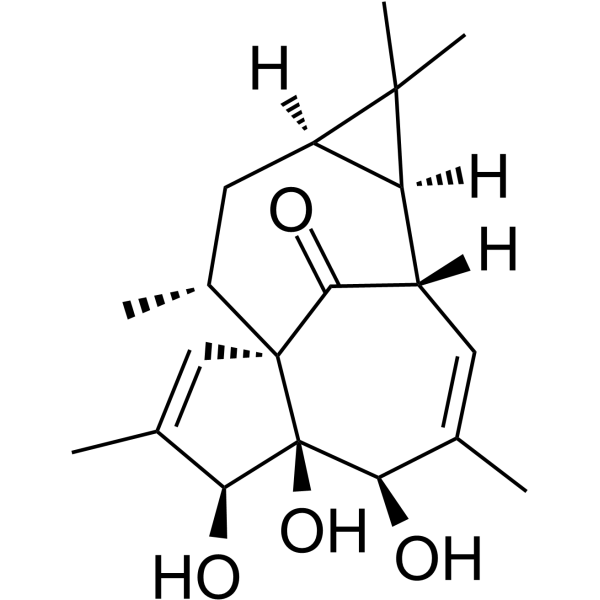
PRODUCTS SPECIFICATIONS [54706-99-9]

DESCRIPTION [54706-99-9]
Overview
| MDL | - |
|---|---|
| Molecular Weight | 332.43 |
| Molecular Formula | C20H28O4 |
| SMILES | O=C1[C@@]2(C=C(C)[C@@H]3O)[C@]3(O)[C@H](O)C(C)=C[C@@]1([H])[C@@]4([H])[C@@](C4(C)C)([H])C[C@H]2C |
1 Publications Citing Use of MCE
Summary
20-Deoxyingenol, a diterpene, is isolated from the roots of Euphorbia kansui . 20-Deoxyingenol can promote autophagy and lysosomal biogenesis by promoting the nuclear translocation of transcription factor EB (TFEB) in vitro. 20-Deoxyingenol can be used for the research of osteoarthritis (OA) [1] [2] .
In Vitro
20-Deoxyingenol (2.5-10 mM; 24 h) protects chondrocytes against Tert-butyl hydroperoxide solution (TBHP; 100 μM)-induced cell death
[2]
.
20-Deoxyingenol (5-10 mM) decreases the TBHP-induced upregulation of apoptosis protein cleaved-caspase3 and the senescence protein p16INK4a in chondrocytes
[2]
.
20-Deoxyingenol (2.5-40 mM; 24 h) has no cytotoxic effect on chondrocytes at the concentration less than 10 mM
[2]
.
20-Deoxyingenol (10 mM; 24 h) restores autophagy flux in TBHP treated chondrocytes
[2]
.
20-Deoxyingenol (4-10 mM; 24 h) promotes the nuclear level of TFEB in TBHP treated chondrocytes
[2]
.
MCE has not independently confirmed the accuracy of these methods. They are for reference only.
In Vivo
20-Deoxyingenol (20 mg/kg/d; i.p. for 8 weeks) alleviates the progression of OA in the DMM model in mice [2] .
MCE has not independently confirmed the accuracy of these methods. They are for reference only.
| Animal Model: | 10-week-old C57BL/6 male wild-type (WT) mice with destabilization of the medial meniscus (DMM) [2] |
| Dosage: | 20 mg/kg |
| Administration: | I.p. one time per day, for eight consecutive weeks |
| Result: |
Had a slightly wider joint space and reduced bone density and calcification compared with the DMM group.
Inhibited the decrease in the thickness of hyaline cartilage (HC), and alleviated the disorder and hypertrophy of chondrocytes in the joint tissues of mice after DMM surgery. Had less erosion on the surface of the articular cartilage and more proteoglycan content. Had more positive staining points of LAMP1 and LC3 II, and less cleaved-caspase3 and P16INK4a. Increased the nuclear level of TFEB. |
Appearance
Solid
Shipping
Room temperature in continental US; may vary elsewhere.
Storage
| Powder | -20°C | 3 years |
|---|---|---|
| 4°C | 2 years | |
| In solvent | -80°C | 6 months |
| -20°C | 1 month |
Solvent & Solubility
DMSO : 50 mg/mL ( 150.41 mM ; Need ultrasonic)
Stock Solutions
| Concentration Solvent Mass | 1 mg | 5 mg | 10 mg |
|---|
| 1 mM | 3.0082 mL | 15.0408 mL | 30.0815 mL |
| 5 mM | 0.6016 mL | 3.0082 mL | 6.0163 mL |
| 10 mM | 0.3008 mL | 1.5041 mL | 3.0082 mL |
References
- [1] Uemura D, et, al. Isolation and structures of 20-deoxyingenol new diterpene, derivatives and ingenol derivative obtained from “kansui”. Tetrahedron Letters. 1974; 15(29): 2527-2528.
- [2] Gu M, et, al. 20-Deoxyingenol alleviates osteoarthritis by activating TFEB in chondrocytes. Pharmacol Res. 2021 Jan 15;165:105361.