[CAS NO. 476-66-4] Ellagicacid
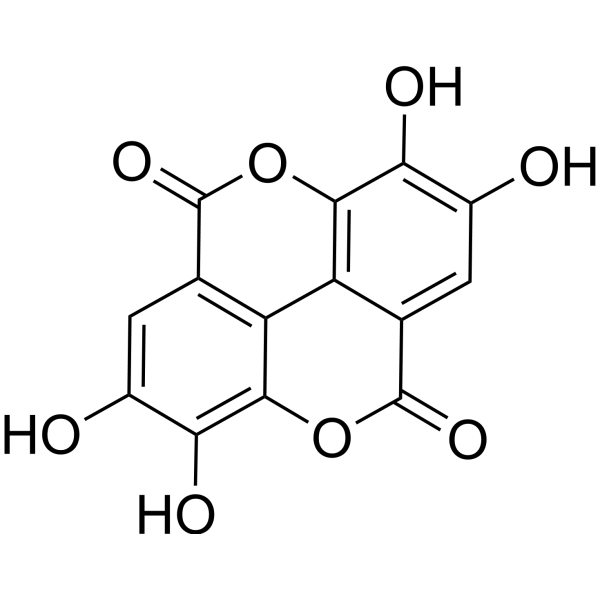
PRODUCTS SPECIFICATIONS [476-66-4]

DESCRIPTION [476-66-4]
Overview
| MDL | MFCD00006914 |
|---|---|
| Molecular Weight | 302.19 |
| Molecular Formula | C14H6O8 |
| SMILES | O=C1C2=CC(O)=C(O)C(O3)=C2C4=C(C3=O)C=C(O)C(O)=C4O1 |
6 Publications Citing Use of MCE
Summary
Ellagic acid is a natural antioxidant, and acts as a potent and ATP-competitive CK2 inhibitor, with an IC 50 of 40 nM and a K i of 20 nM.
IC50 & Target
|
CK2 40 nM (IC 50 ) |
In Vitro
Ellagic acid is a potent CK2 inhibitor, with an IC 50 of 40 nM and a K i of 20 nM. Ellagic acid also blocks other kinases such as LYN, PKA, SYK, GSK3, FGR and CK1, with IC 50 s of 2.9, 3.5, 4.3, 7.5, 9.4 and 13.0 μM, respectively, and shows no obvious effects on DYRK1a, CSK, NPM-ALK, RET and FLT3 (IC 50 s > 40 μM). Ellagic acid (5-100 μM) shows inhibitory activities against Karpas299, SUDHL1, SR786, and FE-PD cell lines [1] . Ellagic acid (10 μM) exhibits cytotoxic effects on MCF-7 cells after treatment of radiation. Ellagic acid (10 μM) in combination with Irradiation (IR) significantly abridges the capacity of MCF-7 cells to form colonies equated with individual treatments. Ellagic acid with IR also induces cell apoptosis, and facilitates the upregulation of pro-apopttotic Bax and downregulation of Bcl-2 in MCF-7 cells [3] .
MCE has not independently confirmed the accuracy of these methods. They are for reference only.
In Vivo
Ellagic acid (EA; 10 mg/kg/day; p.o., 14 days) strongly decreases MDA brain content by 17%, and reduces the levels of brain TNF-α by 42% in rats. Ellagic acid markedly increases the reduced brain contents of 5-HT (39%), dopamine (DA, 71%), and norepinephrine (NE, 77%). Ellagic acid (10 mg/kg, p.o., 14 days) causes decreased histopathological changes induced by Doxorubicin in rats [2] .
MCE has not independently confirmed the accuracy of these methods. They are for reference only.
Clinical Trial
| NCT Number | Sponsor | Condition | Start Date | Phase |
|---|---|---|---|---|
| NCT03713164 | University of California, Los Angeles |
Healthy
|
February 22, 2018 | Not Applicable |
| NCT02263378 | University of Messina |
HPV Infection
|
September 2014 | Not Applicable |
| NCT04011618 | University of Guadalajara|National Council of Science and Technology, Mexico |
Metabolic Syndrome
|
September 17, 2019 | Phase 2 |
| NCT00455416 | Oslo University Hospital|University of Oslo |
Follicular Lymphoma
|
April 2007 | Phase 2 |
Appearance
Solid
Source
Shipping
Room temperature in continental US; may vary elsewhere.
Storage
| Powder | -20°C | 3 years |
|---|---|---|
| 4°C | 2 years | |
| In solvent | -80°C | 6 months |
| -20°C | 1 month |
Solvent & Solubility
DMSO : ≥ 2.5 mg/mL ( 8.27 mM )
Ethanol : < 1 mg/mL (insoluble)
H 2 O : < 0.1 mg/mL (insoluble)
* "≥" means soluble, but saturation unknown.
Stock Solutions
| Concentration Solvent Mass | 1 mg | 5 mg | 10 mg |
|---|
| 1 mM | 3.3092 mL | 16.5459 mL | 33.0918 mL |
| 5 mM | 0.6618 mL | 3.3092 mL | 6.6184 mL |
| 10 mM | --- | --- | --- |
References
- [1] Cozza G, et al. Identification of ellagic acid as potent inhibitor of protein kinase CK2: a successful example of a virtual screening application. J Med Chem. 2006 Apr 20;49(8):2363-6.
- [2] Rizk HA, et al. Prophylactic effects of ellagic acid and rosmarinic acid on doxorubicin-induced neurotoxicity in rats. J Biochem Mol Toxicol. 2017 Dec;31(12).
- [3] Ahire V, et al. Ellagic Acid Enhances Apoptotic Sensitivity of Breast Cancer Cells to γ-Radiation. Nutr Cancer. 2017 Aug-Sep;69(6):904-910.
Synonyms