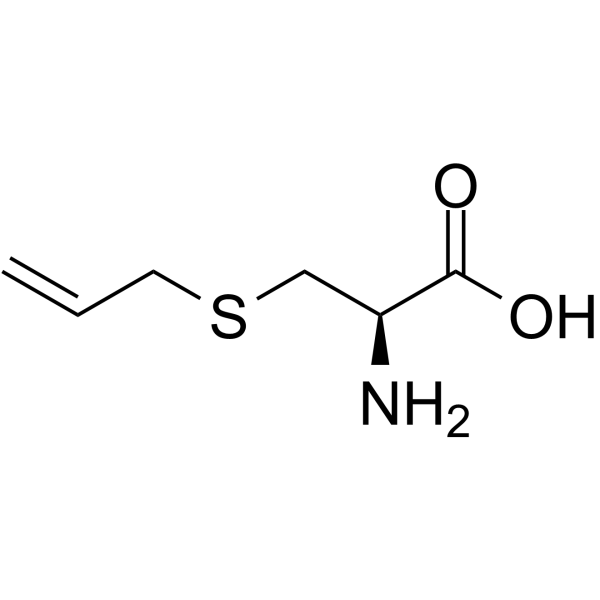
[CAS NO. 21593-77-1] S-Allyl-L-cysteine
PRODUCTS SPECIFICATIONS [21593-77-1]

DESCRIPTION [21593-77-1]
Overview
| MDL | MFCD00151975 |
|---|---|
| Molecular Weight | 161.22 |
| Molecular Formula | C6H11NO2S |
| SMILES | N[C@@H](CSCC=C)C(O)=O |
Summary
S-Allyl-L-cysteine, one of the organosulfur compounds found in AGE, possess various biological effects including neurotrophic activity, anti-cancer activity, anti-inflammatory activity.
In Vitro
It is found that S-Allyl-L-cysteine could protect against amyloid-protein (A)-and tunicamycin-induced cell death in differentiated PC12 cells. Simultaneously applied S-Allyl-L-cysteine (1 μM) suppresses the cell death induced by Aβ 25-35 and Aβ 1-40 in a concentration-dependent manner, and neuronal integrity is almost completely retained. Simultaneously applied S-Allyl-L-cysteine significantly decreases the Aβ-induced level of ROS. The TEAC value of S-Allyl-L-cysteine is lower than that of oxidized GSH, and no antioxidant activity is observed. Intracellular GSH levels remains unaffected by treatment of neurons with S-Allyl-L-cysteine for 24 h. Furthermore, the increase in caspase-12 protein expression is suppressed by simultaneously adding 1 μM S-Allyl-L-cysteine [1] . S-Allyl-L-cysteine up to a concentration 1.0 mM does not exhibit any cytotoxic impact on morphology of myoblast and myotubes in culture observed under bright field microscope. TNF treatment leads to a significant decrease in the intracellular CK activity while S-Allyl-L-cysteine pre-treatment to TNF treated myotubes decreases the release of CK in media. S-Allyl-L-cysteine pre-treatment decreases the level of active form of this enzyme in S-Allyl-L-cysteine+TNF group. Similar observations are recorded at mRNA level for caspase-3. These results illustrate that S-Allyl-L-cysteine regulates apoptotic signals via suppressing the transcription and thus protein expression of caspase-3 [2] .
MCE has not independently confirmed the accuracy of these methods. They are for reference only.
Appearance
Solid
Source
Shipping
Room temperature in continental US; may vary elsewhere.
Storage
| Powder | -20°C | 3 years |
|---|---|---|
| 4°C | 2 years | |
| In solvent | -80°C | 6 months |
| -20°C | 1 month |
Solvent & Solubility
H 2 O : 16.67 mg/mL ( 103.40 mM ; ultrasonic and warming and heat to 60°C)
Stock Solutions
| Concentration Solvent Mass | 1 mg | 5 mg | 10 mg |
|---|
| 1 mM | 6.2027 mL | 31.0135 mL | 62.0270 mL |
| 5 mM | 1.2405 mL | 6.2027 mL | 12.4054 mL |
| 10 mM | 0.6203 mL | 3.1014 mL | 6.2027 mL |
-
1.
Add each solvent one by one: PBS
Solubility: 50 mg/mL (310.14 mM); Clear solution; Need ultrasonic
References
- [1] Kosuge Y, et al. S-allyl-L-cysteine selectively protects cultured rat hippocampal neurons from amyloid beta-protein- and tunicamycin-induced neuronal death. Neuroscience. 2003;122(4):885-95.
- [2] Dutt V, et al. S-allyl cysteine inhibits TNFα-induced skeletal muscle wasting through suppressing proteolysis and expression of inflammatory molecules. Biochim Biophys Acta. 2018 Apr;1862(4):895-906.
Synonyms